
Hallway Lighting Ideas: How to Light an Entrance Well
Good hallway lighting ideas start with a simple observation: the hallway is the room you walk through in the dark more than any other. You come home to it, you cross it on the way to bed, and in winter it is often unlit for most of the day. When the clocks go back on 25 October, it becomes the first room in the house to feel the change.
We spend a lot of our time thinking about light, and not only because we sell lamps. The three videos that have reached the most people on our Instagram this year were all about it: glare from a ceiling light, a dark corner nobody sits in, and a room that felt like an office because of the colour of the bulb. None of them were about a lamp's looks. They were about how a room feels after dark, and the hallway is where that feeling arrives first.
This guide covers the four parts of hallway lighting that make the difference: the ceiling light, a lamp at low level, narrow halls and stairs, and the bulbs themselves, with the measurements and rules that matter.
Light a hallway in layers
Most hallways have one light: a ceiling fitting in the middle, on a switch by the door. It is enough to find your keys, and it is the reason so many halls feel flat and unwelcoming. The fix is the same principle that works in a living room, applied to a smaller space:
- A ceiling light for general light, the one you switch on when you need to see everything.
- A light at low or mid height, a table lamp on a console or a wall light, which is the one that makes the hall feel lived in.
- Something to reflect it, usually a mirror, so the light you have goes further.
In practice the second layer does most of the work. A lamp left on in the evening is what makes coming home feel like arriving rather than passing through.
Hallway ceiling light ideas
The ceiling light is the one you cannot avoid, so choose it for how it spreads light rather than how it looks switched off. Two rules decide it.
Mind the head height. UK lighting maker Industville recommends at least 2.1m between the floor and the bottom of a pendant in a hallway or walkway. In a hall with a typical 2.4m ceiling, that leaves very little room for anything that hangs, which is why a flush or semi-flush fitting with a diffused shade is usually the better choice in a standard hall. Save hanging pendants for halls with real height: a stairwell, a period entrance hall or a double-height landing.
Diffuse the light. A bare bulb or a clear glass shade throws hard shadows down a narrow space. Fabric, paper or opal glass spreads the light across the walls, which makes a hall feel wider.
In a tall entrance hall, a fabric pendant becomes the statement piece. The Kumo gathered fabric pendant is 80cm across, with fine fabric gathered over a brushed iron frame and hung from three dark chains, and the light passes through the fabric as a soft, even glow. It has an overall drop of 120cm, so it needs a high ceiling to keep clear head height. The Linen Wave pendant, in hand-pleated natural linen on a single adjustable cord, does the same job with a lighter look. Both sit in our fabric and linen pendant lights.

Put a lamp on the console
If your hall has room for a console table, a shelf or even a deep windowsill, a table lamp is the single most effective light you can add. It sits at eye level, it lights the wall rather than the floor, and it is the light you can leave on at dusk without lighting the whole house.
Three things make a hallway lamp work:
- A wide, light shade that throws light up and down the wall rather than into a tight spot.
- A plug socket within reach, so you are not running a cable across the floor. A plug-in timer or a smart plug means the lamp is on before you get home.
- Scale. On a slim console 25 to 35cm deep, choose a lamp with a narrow base.
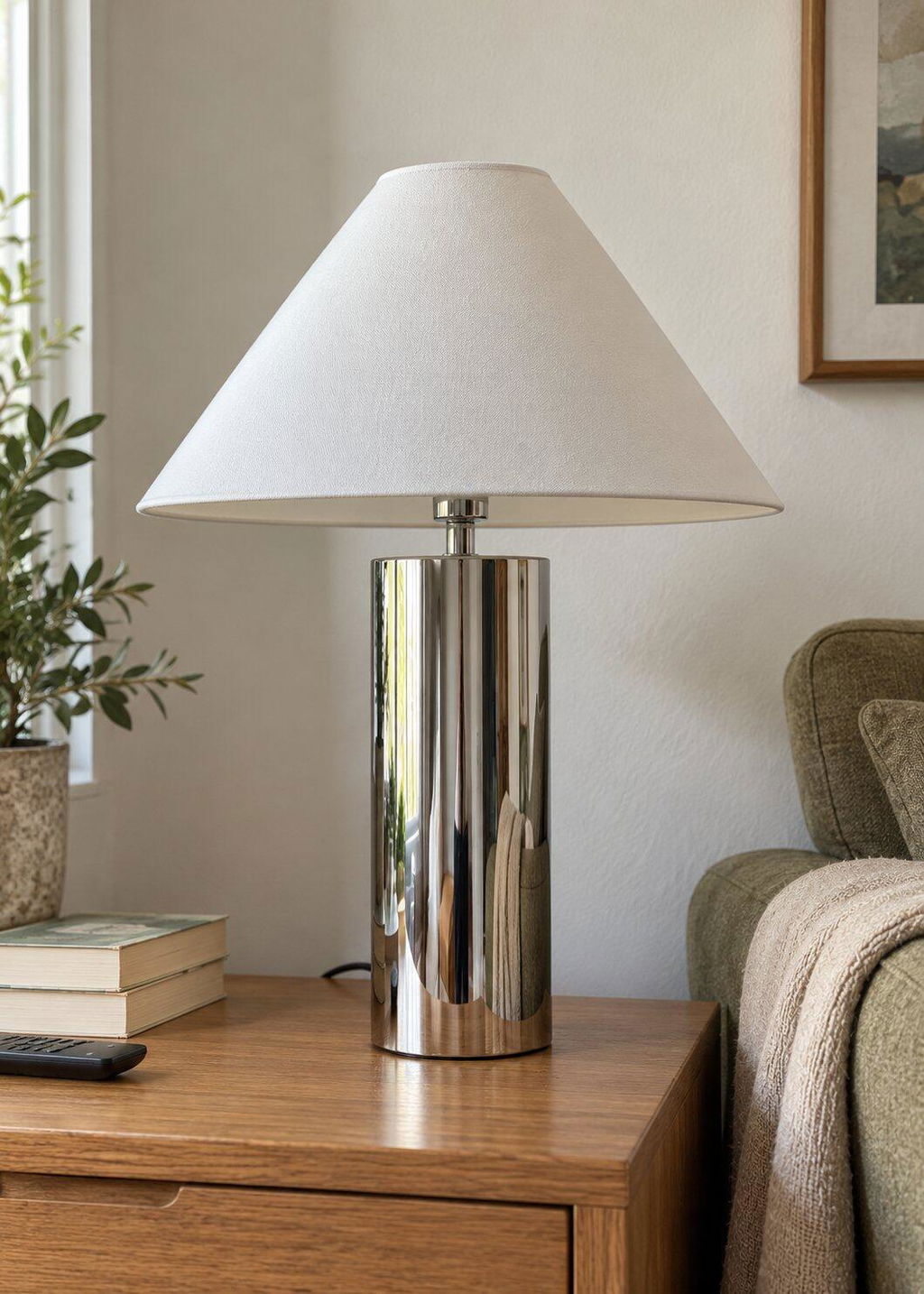
The Chrome Column table lamp has a 12cm base under a 40cm white conical shade, so it suits a narrow console and spreads a wide, warm light up the wall. For warmer materials, the Rinkaku wooden table lamp stands 50cm tall on a handcrafted wooden base, and the Marble Column table lamp casts a focused pool of light from under a dark charcoal shade, better where you want a glow on the console itself, by the keys and post. The full range is in our table lamps.

In a wide hall with floor space to spare, a floor lamp beside a bench or chair does the same job at full height. Our floor lamps include slim wooden and chrome columns that fit a corner.
Narrow hallway lighting ideas
A narrow hall is the hardest to light, because there is no room for furniture and every light is close to your head. A few ideas that work:
- Keep the ceiling light flat. In a narrow hall, a flush fitting avoids anything you could walk into.
- Use more than one ceiling point in a long hall, so the far end is not left in shadow. A long, narrow hall lit from one central point always has a dark end.
- Light the walls, not the floor. Wall lights or uplighters tend to make a narrow space feel wider than a single light pointing down at the floor.
- Use a floating shelf instead of a console. Below about 100cm wide, a console blocks the walkway; a shelf 15 to 20cm deep still holds a small lamp and a dish for keys.
- Add a mirror where the light is. A mirror does not make light, but it reflects the light you already have, from a lamp or the door glass, back into the hall.
The Mizu full length mirror stands on a low base with discreet wheels, so it can be rolled into the spot where it catches the most light without drilling the wall. Opposite a lamp or near the front door is usually that spot.

Choose the right bulb colour
Bulb colour changes how a hallway feels more than the fitting does. Colour temperature is measured in Kelvin: warm white sits at roughly 2700K to 3000K and is usually recommended for living spaces, while cool white (3500K to 4000K) and daylight bulbs are aimed at kitchens, bathrooms and workspaces.
For a hallway, we would use warm white throughout, around 2700K. A hall is the link between rooms, so a cool bulb there makes the change into a warm living room feel abrupt, and a cool light in a small space with no daylight reads as clinical. Two more small things help:
- Match the colour of every bulb in the hall and landing. Mixed whites look like a mistake.
- Fit a dimmer to the ceiling light if you can. Full brightness for cleaning or finding a lost glove, half for the evening.
If your hall is dark in colour as well as light, our guide to the dark Japandi hallway covers how to light a deep palette, and our dark Japandi guide explains why warm, low light suits it.
Lighting the stairs and landing
The stairs are where hallway lighting stops being about atmosphere and becomes about safety. The Society of Light and Lighting, part of the building services body CIBSE, publishes a whole guide on lighting stairs, covering glare, where to place fittings so nobody walks into them, and controls such as presence detectors and timers. A few practical points for a home:
- Switch the stair light from both ends. Two-way switching, at the bottom of the stairs and on the landing, means nobody climbs in the dark.
- Light the treads, not your eyes. A fitting that shines straight at you as you climb causes glare. Low wall lights beside the stairs, or a ceiling light set back over the landing, are easier on the eye.
- Consider a sensor on the landing. A low light on a presence sensor helps at night without waking the house.
What you can change yourself
Some lighting work in England and Wales has to be notified under Part P of the Building Regulations. According to the Institution of Engineering and Technology, replacing an existing light fitting, or adding a lighting point to an existing circuit, is not notifiable outside a bathroom or other special location. Installing a new circuit or replacing a consumer unit is.
So swapping a hallway pendant for a new one is usually straightforward. Adding wall lights may mean new wiring, and in our view any fixed electrical work is a job for a registered electrician. A table lamp on a timer needs nothing at all, which is part of its appeal.
Putting it together
A well-lit hallway needs less than you might think:
- a diffused ceiling light on a dimmer, flush in a standard hall or a fabric pendant in a tall one;
- one lamp at low level, on a timer for winter evenings;
- a mirror placed where it catches that light;
- warm white bulbs, the same colour throughout.
Then a place to put things down: a dish for keys and a rail like our walnut hook rail, so the lamp lights a tidy hall rather than a pile of coats. The same thinking applies to the dining room, which our guide to dining room lighting ideas covers.
Shop hallway lighting
Start with one lamp, then the ceiling.
Frequently Asked Questions
What is the best lighting for a hallway?
Layered lighting: a diffused ceiling light for general light, a table lamp or wall light at low level for atmosphere, and a mirror to reflect it. Warm white bulbs around 2700K suit most hallways best.
How do you light a dark hallway with no natural light?
Add light at more than one height. Keep a diffused ceiling light on a dimmer, put a lamp on a console or shelf and leave it on in the evening, use warm white bulbs, and place a mirror where it reflects the lamp or the door glass back into the hall.
How low should a pendant light hang in a hallway?
Leave at least 2.1m between the floor and the bottom of the pendant, which is the clearance UK lighting maker Industville recommends for hallways and walkways. In a hall with a standard 2.4m ceiling, a flush or semi-flush fitting is usually the better choice.
What colour light bulb is best for a hallway?
Warm white, around 2700K to 3000K. It matches the living rooms the hall leads into and avoids the clinical look of cool white in a small space without daylight. Use the same colour for every bulb in the hall and landing.
Do I need an electrician to change a hallway light?
Replacing an existing fitting, or adding a light to an existing circuit, is not notifiable under Part P in England and Wales outside a bathroom or other special location, according to the IET. A new circuit is notifiable. We would always use a registered electrician for fixed wiring; a table lamp on a timer needs no work at all.