
From Timber to Table: Making a Hira
Most coffee tables arrive as a flat pack and a sheet of instructions. This one arrived as four solid planks of reclaimed timber, two block legs, and the marks of a life it had before it reached us. This is how one reclaimed wood coffee table, our Hira, came together in the workshop: from raw boards to a low, monolithic form in dark waxed oak. It is a hand-built, solid wood coffee table with nothing hidden, and because the timber is reclaimed, no two are ever the same.
Where a Hira begins
Every Hira starts as reclaimed solid timber, chosen board by board for depth of grain and the patina that only age gives. The boards for this table were over sixty years old, and they carried it openly: sawn ends, splits, old fixings, the soft grey weathering of wood that has been out in the world and put to use.
Nothing about them was uniform, and that is exactly the point. Every Hira begins this way, from reclaimed timber with a life already behind it, so each table carries its own history and no two are ever alike.

The reclaimed boards before work began.
The form takes shape
Four substantial planks run the full length of the top, carried on two chunky block legs. Together they create Hira's low, monolithic profile, sitting just 23cm from the floor. At this stage the table is still on its workshop supports while the top is worked, so you can read the raw construction before any finish settles it down.
From above, the four planks show their differences plainly: knots, old nail lines, and bands of darker and lighter grain running the length of the piece. The name helps explain the intent. Hira means flat, or level, in Japanese, and the table earns it through form rather than decoration.

Still on its workshop supports as the top is worked.

Four planks run the full length of the top.
The finish comes in slowly
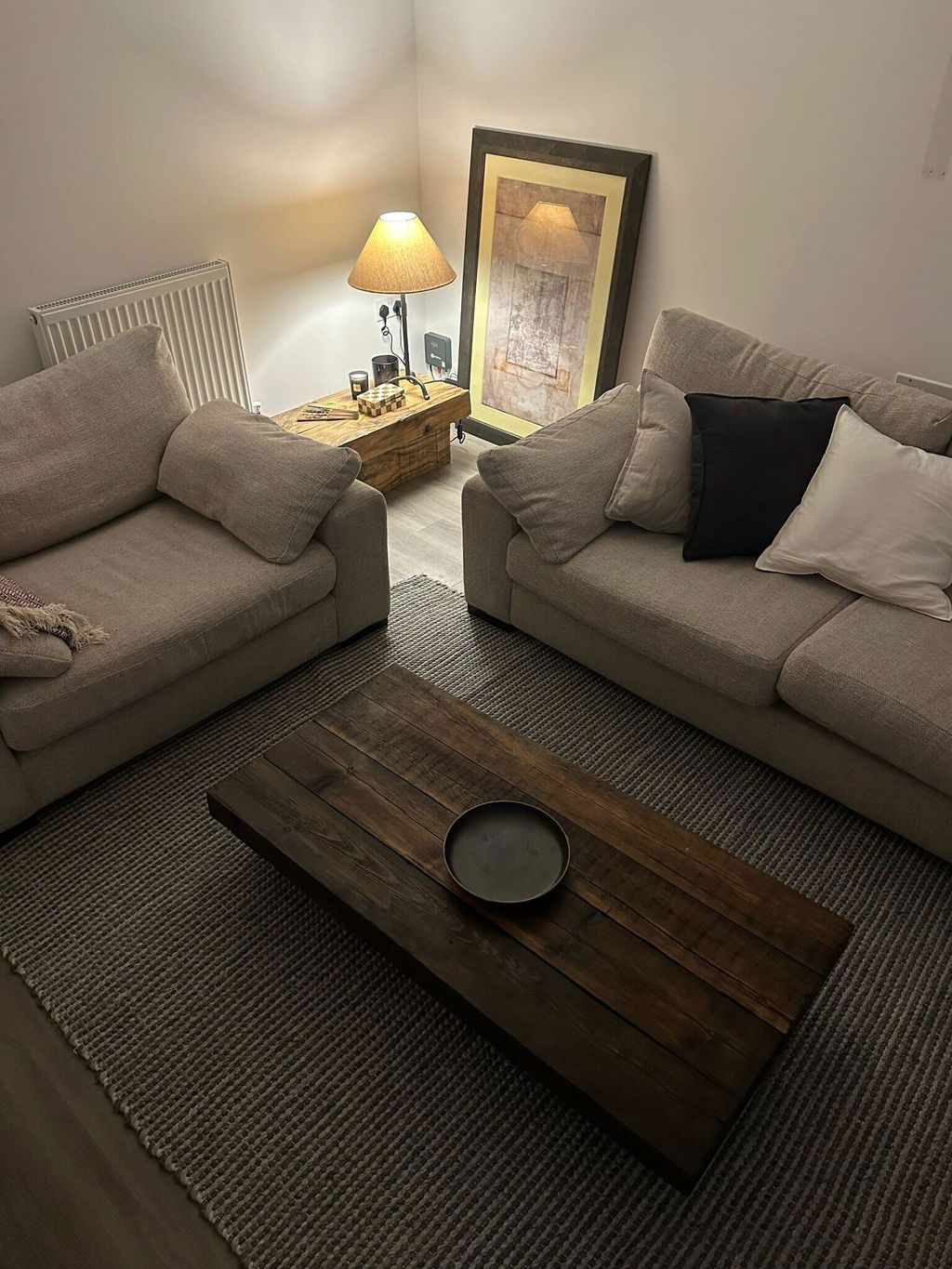
Colour is built, not applied in a single coat. Over a dark walnut stain, successive layers of premium beeswax deepened and evened the tone, drawing the lightest boards closer to the darkest without flattening them into one shade. The final coats settled the piece into a darker, more even finish, and set down at its full height it reads as a single dark mass from across a room, then breaks back into individual planks as you come closer.
Reclaimed timber will never be one uniform colour, and we would not want it to be. The variation, the grain and the patina are the record of what the wood was before. Finishing brought the piece into balance; it did not erase its history.

Set down at full height in dark waxed timber.

Grain, knots and natural tonal variation up close.
Finished, the four planks read as one deep, even tone, the lightest boards drawn close to the darkest while every knot and grain line stays visible.

The finished table, deep and even after its final waxing.
Ready for its next chapter
A piece this heavy, roughly thirty to forty kilograms of solid timber, earns careful packing. It is wrapped first in protective honeycomb kraft, then boxed in cardboard, tied and banded onto a pallet, protected edge to edge before it leaves the workshop. The last thing we do with a Hira is make sure it travels as well as it was built.

Boxed, tied and palletised, ready for its next chapter.
Living with reclaimed timber
A reclaimed timber table is not low-maintenance in the way a sealed factory finish is, and that is worth knowing before you buy. Keep it out of strong, direct UV, wipe spills straight away, use a coaster under anything wet or hot, and give it an occasional coat of wood wax to keep the depth of colour. In return you get a piece that ages with you rather than wearing out.
Because every Hira is built to order in our UK workshop, dimensions can be adjusted to suit a specific room or project. The standard piece is approximately 122cm long, 60cm deep and 23cm high, which works as a low centrepiece for a large sofa, a sculptural plinth between two seats, or a grounding table in a commercial or hospitality interior.
Shop the Hira coffee table
The Hira is built to order as a low, solid wooden coffee table in dark waxed reclaimed timber. You can see it, and its plinth-style sibling, in our wooden coffee tables collection. For styling ideas, our Japandi living room guide covers how to style a coffee table. If you specify for hotels, restaurants or workspaces, our Japandi hotel design guide is a useful starting point.
Frequently asked questions
What is a reclaimed wood coffee table?
It is a coffee table built from timber that has already had a previous life, rather than newly milled boards. The wood is selected, cleaned and reworked, so it keeps the grain, marks and patina of its history while becoming a new, solid piece of furniture.
Is reclaimed timber durable enough for a coffee table?
Yes. Reclaimed structural timber is often denser and more stable than fresh softwood because it has already dried and settled over decades. Finished with stain and wax and built as a solid form, it is made to be used every day.
Why is the colour uneven on reclaimed wood furniture?
Because each board aged differently in its former life. Finishing can draw the lightest and darkest areas closer together for a more cohesive look, but it will not, and should not, erase the natural variation that tells you the wood is genuinely reclaimed.
How do you care for a waxed reclaimed wood table?
Keep it out of strong direct sunlight, wipe spills promptly, use coasters, and apply an occasional coat of wood wax to maintain the depth of colour. Avoid harsh chemical cleaners, which strip the wax.
Can the Hira coffee table be made to custom dimensions?
Yes. Every Hira is hand-built to order in our UK workshop, so the length, depth and height can be tailored to suit a specific room or project.
Where is the Hira coffee table made?
It is designed and hand-built in the United Kingdom from reclaimed solid timber.